You may have already heard of the four attachment styles:
Secure attachment - low anxiety, low avoidance. There’s trust, comfort with intimacy, and the ability to communicate needs and openly receive a partner’s communication without becoming combative or dismissive.
Anxious attachment - high anxiety, low avoidance. A constant need for external validation and assurance. Even when things are quite and “normal,” there’s a fear of either rejection or abandonment. Drama may be created to find closeness again.
Avoidant attachment - low anxiety, high avoidance (hence the name).
You used to just be a teacher, coach, boss, mom or dad. But now? In every role you’re a part-time therapist, mentor, empathy-giver, boundary enforcer, etc.
Roles are expanding. The self is expanding.
Relationships aren’t neceessarily asking more from us. Life is. And because of that, we often rely more on relationships than that relationship can hold. With that, unless you’re adapting to the times, you may also notice relationships are falling apart faster than ever.
Here’s what to do about it: the healthiest relationships move through three levels.
The “why” or how something came to be can be important. Insight can be important. But often, as someone is on the precipice of breakthrough, “why’s” can hijack the body and heart from melting into change.
Yes— it may sound strange to hear a therapist sat you don’t need more insight. But we’re saturated with insight. We can watch a thousand videos on attachment styles and origin of trauma, but if it’s not translating to meaningful change in a present moment, more insight is endless speedbumps.
Automation is life. What isn’t automated goes extinct.
Any inconvenience in which we have to sit with uncertainty for longer than a few seconds feels uncomfortable…even foreign for our nervous system. And when one part feels vulnerable, another part searches for an exit.
• We sense emptiness, a part of us seeks distraction. • We sense shame, a part of us hides. • We sense inadequacy, a part of us seeks self-improvement.
I remember the waiter gave us some styrofoam boxes to pack our leftovers. We were confused. The waiter said their new policy was to have customers pack their leftovers. Soon after, this trend was everywhere.
The process of offloading energy, service, and cost to customers has only been increasing. Last week was another first for me: 3% fee for a credit card… for servicing my car! From every angle we’re being commoditized.
Without our consent, we’ve had to pick up the pieces—but we’ve got limits on what our souls can handle. Each added responsibility increases pressure within. Everyone feels it.
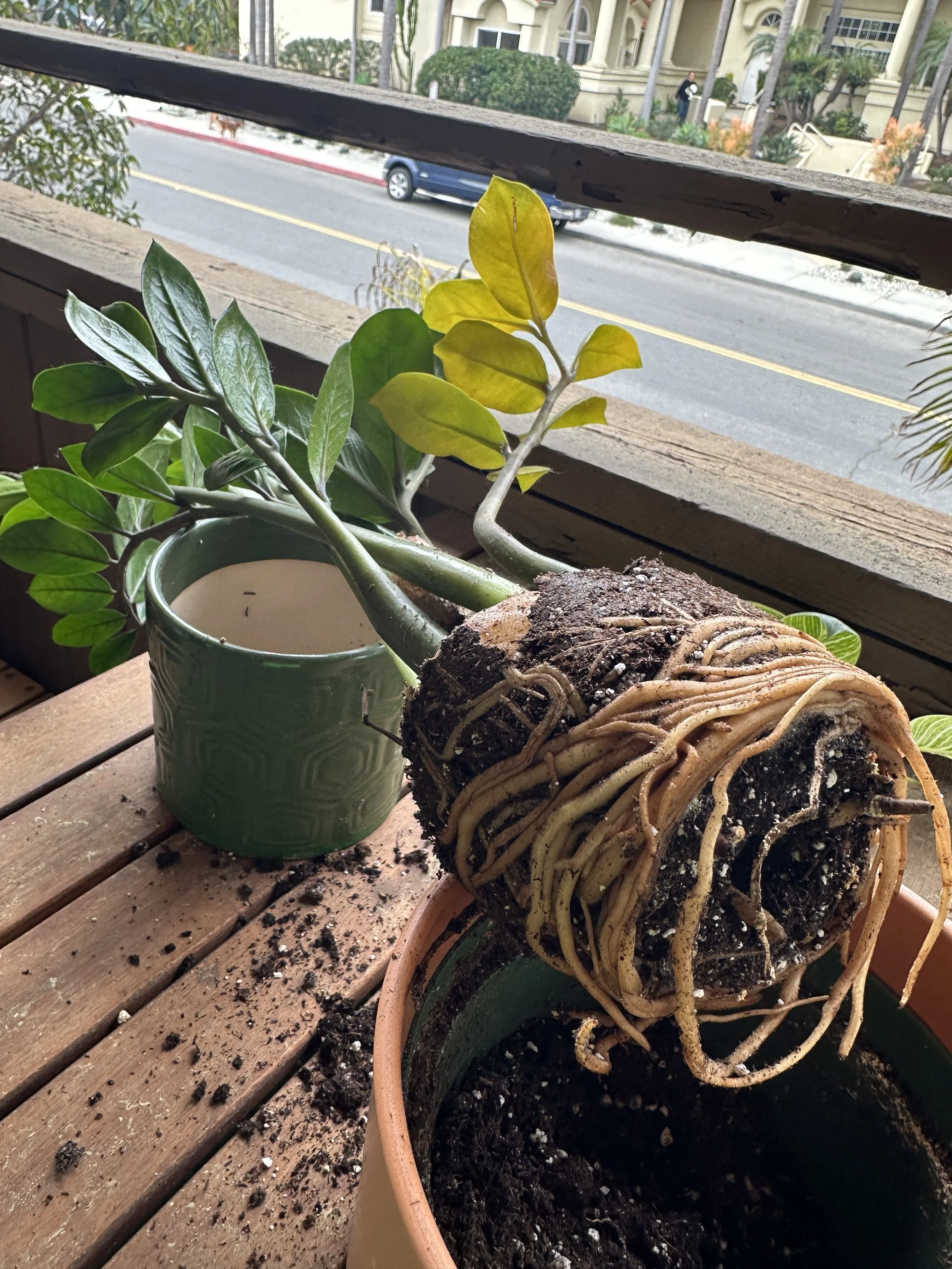
Have you ever repotted a plant? It’s an odd little ritual.
Sometimes the roots slip right out—clean, easy, cooperative. But other times, the plant’s withered fingers grasp the pot’s interior for dear life. You must pre-water the soil, pry gently along the edges, coaxing it loose. Eventually, you cup the plant’s wispy buttocks and lift—presenting it to the world like a baby Simba. (At least, that’s how I do it.)
The contrast is apparent. Above soil: vibrant greenery, stretching toward the light. Below: a web of roots, tangled and clumped dusty computer cables. The plant looks alive and wants to expand, but there’s literally no room for growth. It’s been stuck—unable to grow—perhaps for a long time.
Men’s issues are rarely spoken about. If put in the open, they’re often not taken seriously or even made fun of. On top of that, they’re evolving.
What worked in the past is outdated. A few decades ago, the primary role of a man was to provide and protect. Now there’s role confusion.
As a therapist for men’s issues in San Diego and a telehealth therapist, I often see this pattern: even if a man is checking off all the boxes, there’s still a feeling that prevails…it’s still not enough.
People commonly date a partner based on preferences. A range of height and build. A shared love of sushi, acoustic playlists, or Sunday farmer’s markets. Preferences create comfort.
Go one layer deeper and we meet values—religion, work ethic, health, wellness. Shared values create stability.
In the past, comfort + stability was enough. But not anymore.
We live from our set of values. Like grooves on a record, after enough spins, we struggle to imagine how anyone could live by another song—another code.
In relationships, both people are playing their own record. This difference in rhythm can either heal us or break us.
We often think, if only my partner understood how I operate, we’d get along better.
But it’s precisely this polarity that fuels intimacy.
In our bones we feel the tension from where we are to where we want to be.
In the space from where we are to where we want to be, there’s one piece missing containing two ingredients: directed energy. Without increasing your directed energy, your life can’t change its trajectory.
Directed energy is like a car. Energy is the motor, direction is the steering wheel. You can still drive if you have a partially working motor or steering wheel—but if you want to get to your desired destination, both must be fully operational.
The way we speak about ourselves quietly shapes the way we live.
We toss off phrases like, “I’ve got anxiety,” “I’ll never be able to afford a house,” or “I’m not a morning person,” without a second thought. They might feel honest, even factual. But are they aligned with the future we’re trying to create?
Language is more than expression—it’s direction. We tend to live into the truths we repeat most often, especially when they begin with “I.” The stories we speak become the filters through which we see ourselves, our choices, and our possibilities.
Even a gentle reframe can open a new emotional window.
Sometimes we know exactly what’s going on in someone’s head. We know their reaction. We know their mannerisms of how they’ll respond.
—But more often than not, we don’t know. Or, more accurately, what’s going on for them is more nuanced than we’d dare to realize. It’s a good thing. In the collective consciousness, we’re able to connect to ourselves on a deeper level.
When I help a client identify emotions given a stressful situation, they may have half a dozen (seemingly conflicting) emotions and narratives. Further, what they initially believed they felt was merely protecting what they truly felt.
To flow in the highest stage of consciousness, I’ll share a secret from Michael Phelps, winner of an unprecedented twenty-three Olympic gold medals. When I heard the aftermath of a particular race at the 2008 Beijing Olympic Summer Games, I was mesmerized.
In childhood, we learn what emotions are safe and unsafe to experience. We develop strategies and personalities to protect ourselves from reexperiencing the unsafe emotions. Unhealed, these emotions are active wounds, open and exposed to more pain.
You can’t skip the healing process; the more a person runs from their emotions, the more those emotions run their life. Most people are rarely aware of the emotions they avoid, yet they may be aware they continually experience the same undesirable situations.
I remember when I first consciously felt the result of exchanging money for time. My apartment was in need of a deep clean. For weeks I’d tell myself I’d clean, but due to heavy work hours, I put it off. At the time, my moral compass wouldn’t allow me to hire someone to clean my filth. Eventually though, I caved.
When I came back to my apartment after the cleaning, it was lemon-smelling and bright white. Waves of new energy—gratitude, joy, and expansion—enter my soul. Initially, I felt bad for the cleaner, but he was excited and gracious for four hours of work. The energy exchange felt amazing.
Our culture moves so quickly. We jump from task to task, idea to idea. We’ve got more to do with less time. The effort to become an individual—to create personal boundaries, meaning, and worth (which is no easy task!)—can come at the expense of a relationship. Often, our energy exchange with one another becomes transactional, naturally interacting with others by what we can get out of them to meet our own purpose.
As people are waking up more to how they feel, they also notice that in this newer energy exchange, and often true, authentic connection feels lacking; genuine connection is efficiency’s casualty. And when a person feels emotionally disconnected with another (i.e. a spouse or a parent to a child, etc.), they often use a “redirect” to communicate:
When you’re in a good flow, life is less about making “right” decisions and more being in tune with yourself, others, and your surroundings. You’re making choices and creating life from spaces that didn’t seem available prior. Being a fuller, more alive version of yourself is knowing you have the capacity within to create change.
How do you effectively create change?
As you know more about yourself, meaning you’re aware of the unconscious scripts you’re operating from, and then, taking the courage to step out of that box, you now create newness. Well then, what are your scripts and how can you change them?
Culturally, anger, more so than any other emotion—such as sadness, disappointment, grumpiness, frustration, regret, guilt, hurt, etc.—is shunned. I often hear clients lament, “Ugh, I shouldn’t have gotten angry though.” When someone doesn’t feel heard, seen, or accepted, resulting in emotions of hurt or shame, which are primary emotions, a protective mechanism comes up. That protection is a secondary emotion, likely anger.
For most people, it’s emotionally safer to have others attack the protective shield of anger, rather than know the more vulnerable feelings of hurt or shame. How can you know anger is mounting?
If you’ve ever competed in anything, you know the work you’ve invested in shows up. You can’t fake it because in stressful situations, your mind is less conscious. Your body will unconsciously carry out what is most real to it. It doesn’t matter whether you’re taking a licensure test or you’re in the NBA Finals; when it’s foreign territory what your soul is most comfortable with, you’ll execute.
The same is true relationally. The work you put in matters. Relationships are filled with stress. Even if you know what you should be saying and doing, whatever is most comfortable for you, you’ll execute.